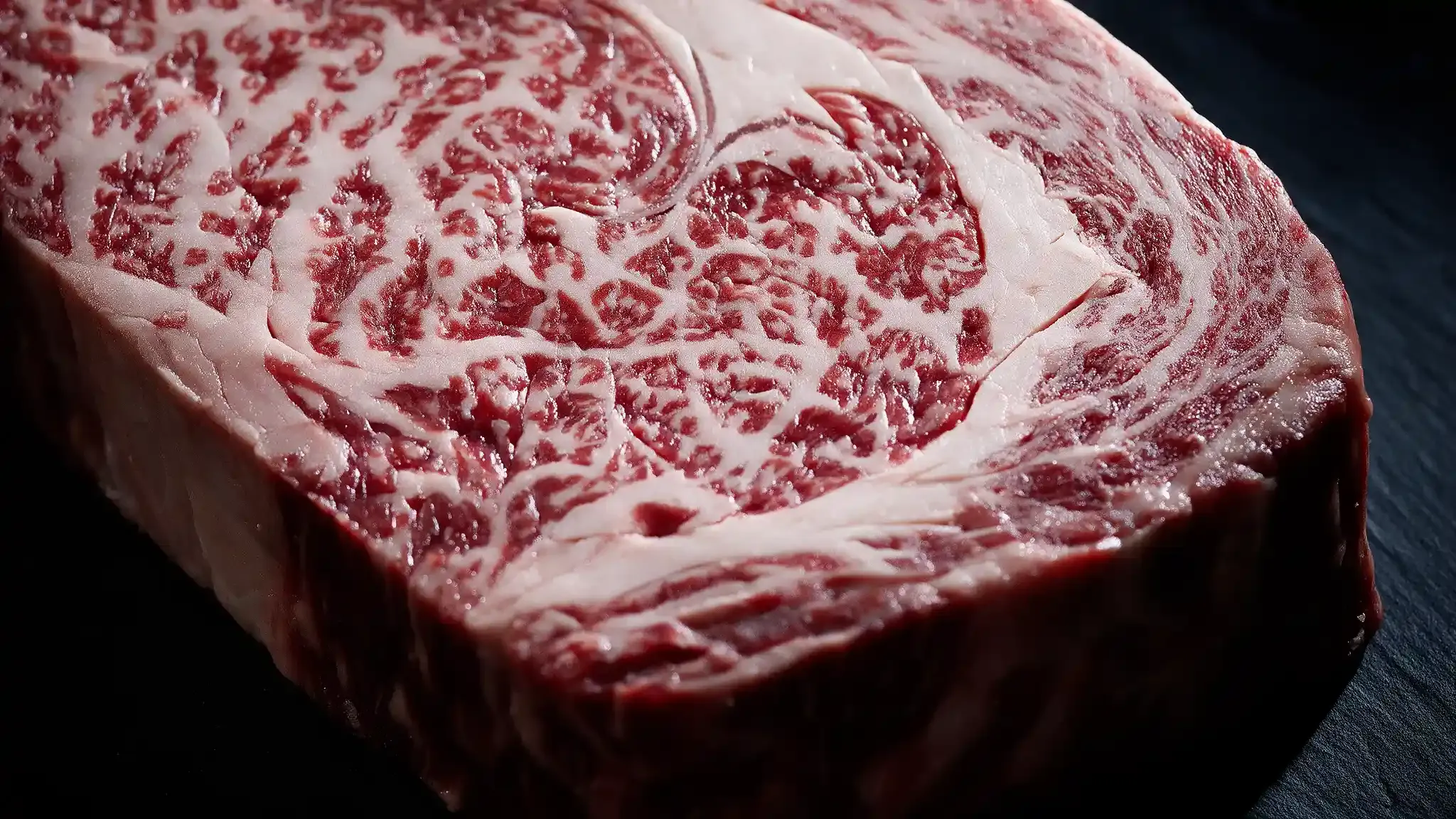
Porterhouse vs Scotch Fillet vs Eye Fillet
Porterhouse has a firm bite and a fat cap that renders over heat. Scotch fillet is richer and more marbled, making it forgiving to cook. Eye fillet is the most tender and the leanest, with the least beef flavour. Order porterhouse for balance, scotch for richness, eye fillet for texture.
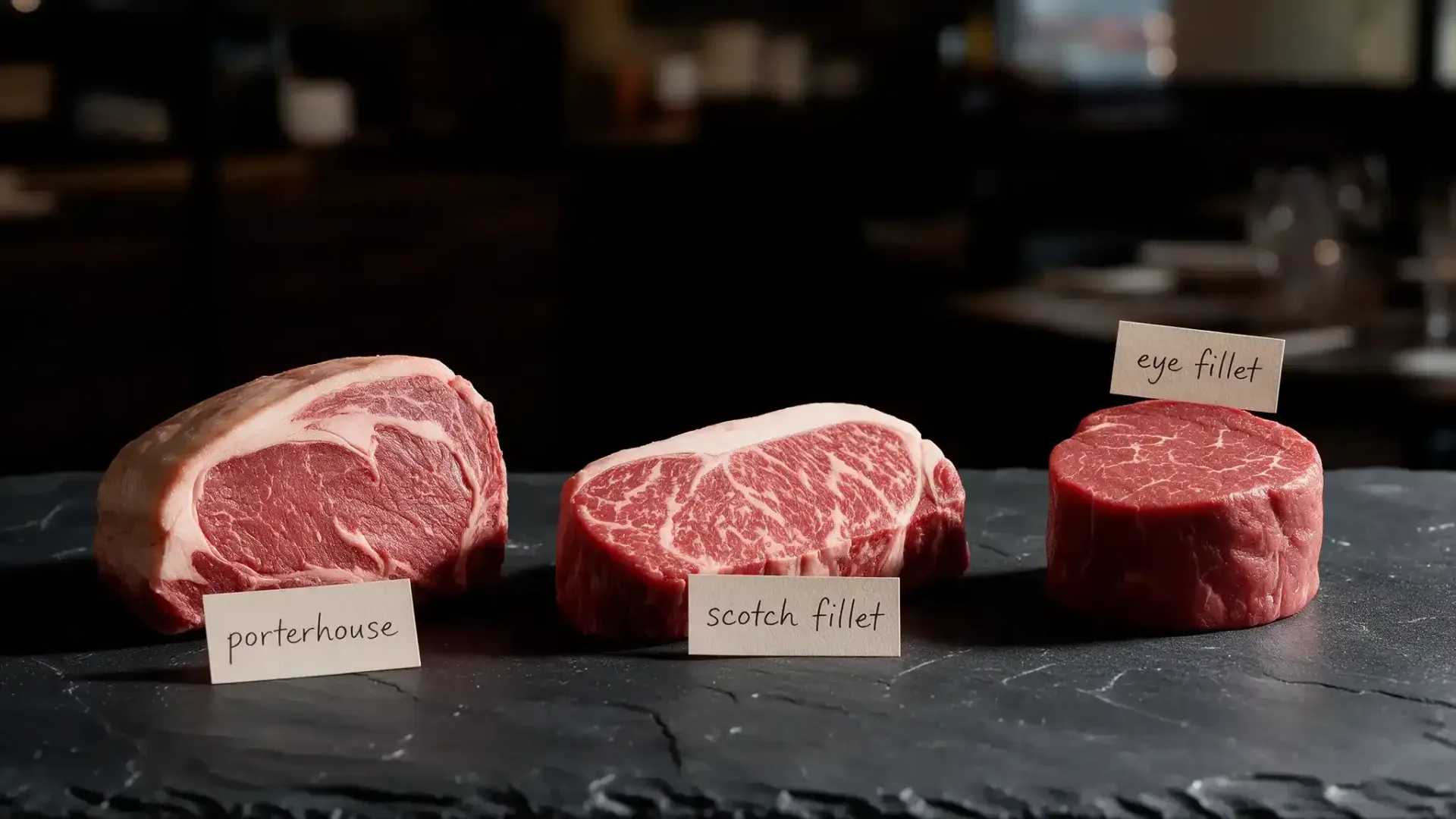
The short answer
Porterhouse if you want a proper steak experience with some chew and a rendered fat cap. Scotch fillet if you want richness and a cut that forgives a minute too long on the grill. Eye fillet if tenderness matters more to you than beef flavour.
Everything below is why.
Where each cut comes from
This is the part that explains everything else. A muscle's texture is determined largely by how hard the animal worked it.
Porterhouse — the sirloin
Cut from the back, along the spine, behind the ribs. Moderately worked, so it has structure and a genuine bite. A strip of fat runs along one edge.
Also sold as sirloin in Australia and as New York strip in the United States. Confusingly, an American 'porterhouse' is something else entirely — a large T-bone. If you are reading a US recipe, translate first.
Scotch fillet — the ribeye
From the rib section, forward of the sirloin. Less worked, and carrying substantially more intramuscular fat, which is what marbling is.
It has a separate cap of muscle wrapped around the outside called the spinalis dorsi. Many chefs consider it the single best mouthful on the animal. If it arrives intact on your plate, save it.
Eye fillet — the tenderloin
A long, narrow muscle that runs beneath the spine and does almost no work at all. That is the entire reason it is tender, and also the reason it is lean.
Sold as tenderloin, and as filet mignon when cut into thick rounds.
It sits under the spine, protected, doing nothing but existing. There is a general rule in butchery that the harder a muscle works the more flavour and the less tenderness it develops, and the tenderloin is that rule at its most extreme.
How they compare
Texture: eye fillet is the most tender, scotch fillet sits in the middle, porterhouse has the firmest bite of the three.
Flavour: scotch fillet is the richest because of the marbling, porterhouse gives the cleanest beef flavour with the bonus of the rendered fat cap, eye fillet is the mildest.
Forgiveness: scotch fillet is the most forgiving of overcooking, because the fat keeps it moist. Eye fillet is the least forgiving, because there is no fat to protect it. Porterhouse sits between.
Price: eye fillet is typically the most expensive per kilo, because there is very little of it on each animal. Scotch fillet usually follows, then porterhouse.
Yield explains most of that. A carcass produces only two tenderloins, each a few kilos, and demand for them is high precisely because they are easy to eat. Scarcity and convenience together set the price rather than eating quality alone.
Portion size: eye fillet is usually served thicker and lighter, porterhouse and scotch fillet flatter and heavier. Two 250g steaks of different cuts can look very different on the plate.
One more distinction worth knowing
Porterhouse and scotch fillet are both cut across a single muscle group, which is why they cook evenly. Eye fillet tapers along its length, so a whole tenderloin produces steaks of different thickness and the thin end cooks faster.
If you are served an eye fillet that is noticeably narrower than the classic thick round, it came from the tail end and will cook through more quickly than you expect.
Which to order, by situation
First time at a restaurant that cooks over fire: porterhouse. It shows most clearly whether the kitchen knows what it is doing.
You like your steak medium or above: scotch fillet. The marbling gives you protection that eye fillet does not.
You want something you barely have to chew, or you are eating late and do not want a heavy meal: eye fillet.
You are not sure and want the most flavour for the money: rump, which is not in this comparison and is consistently underrated.
Cooking each one
Porterhouse benefits from the fat edge being rendered directly — held against the heat on its side before the flat faces go down. Skip that and the fat arrives chewy rather than caramelised.
Scotch fillet handles high heat well and can take a slightly longer cook. Its irregular shape means it will cook unevenly, which most people find is a feature rather than a fault.
Eye fillet is thick and narrow, so it wants high heat briefly and then rest. It is the cut most often ruined by cooking it the way you would cook a flatter steak.
All three need resting. A steak that goes straight from grill to table has not finished cooking and will leave its juice on the plate rather than keeping it in the meat. Roughly half the cooking time is a reasonable rest for a thick steak.
What to drink with each
Porterhouse suits a shiraz with some oak — enough structure to meet the rendered fat cap without overwhelming the cleaner beef flavour underneath.
Scotch fillet takes a cabernet well, because the tannin cuts through the marbling. This is the cut where a bigger red genuinely earns its place.
Eye fillet is the one to pair lighter. A pinot noir or a lighter-bodied red suits it, because a heavy wine simply flattens a lean, delicate cut.
Where marbling fits in
Marbling is measured in Australia on the AUS-MEAT scale from 0 to 9+, and separately by Meat Standards Australia on a scale of 100 to 1190. Higher scores mean more intramuscular fat and therefore a richer eating experience.
A marble score applies to any cut. A highly marbled porterhouse can be richer than a poorly marbled scotch fillet, so the cut tells you about texture and the marble score tells you about richness. They are two separate pieces of information and worth asking about separately.
A note on names
Australian and American cut names diverge in ways that cause genuine confusion. Australian porterhouse is American New York strip. Australian scotch fillet is American ribeye. Australian eye fillet is American tenderloin.
If a menu uses American terms, it is either an American-style restaurant or someone has copied a US menu. Neither is a problem, but it is worth knowing what you are ordering.
Rump is called rump here and sirloin in the United States, which reverses the Australian meaning of sirloin entirely. It is the single most confusing overlap in the two vocabularies.
The verdict, if you want one
Porterhouse is the best all-round order and the fairest test of a kitchen. Scotch fillet is the best choice if you want richness or you like your steak past medium-rare. Eye fillet is the right answer only if tenderness is genuinely your priority.
And if none of those appeal, order the rump and put the difference into a better bottle.
There is no wrong answer here, only a mismatch between what you ordered and what you actually wanted. Knowing which muscle did what work is enough to avoid that, and it is most of what a butcher knows that a diner does not.
See our current cuts and prices, or read about our wood-fired steakhouse. For a fuller guide to ordering steak, that article covers doneness and etiquette too. Pair your order with wine to match each cut — or if you are nearby, see where Bentleigh diners go for steak.
FAQ block
What is the difference between porterhouse and scotch fillet?
Porterhouse comes from the sirloin and has a firm bite with a fat cap along one edge. Scotch fillet comes from the rib and has more marbling running through it, making it richer and more forgiving to cook.
Is eye fillet better than scotch fillet?
Not better, different. Eye fillet is the most tender and the leanest, with less beef flavour. Scotch fillet is richer and more flavourful but firmer.
Which steak cut is the most tender?
Eye fillet, because the muscle does almost no work. That tenderness comes at the cost of flavour, since the cut is also the leanest.
Is Australian porterhouse the same as American porterhouse?
No. Australian porterhouse is the equivalent of an American New York strip. An American porterhouse is a large T-bone containing two different muscles.
Which cut is best if I like my steak well done?
Scotch fillet. The marbling keeps it moist through a longer cook, where eye fillet dries out quickly because it has no fat to protect it.
What is the spinalis on a scotch fillet?
A separate cap of muscle wrapped around the outside of the ribeye. Many chefs consider it the best-eating part of the cut.