Sher Wagyu Explained: What Marble Score Actually Means
Marble score measures the intramuscular fat running through beef. Australia uses the AUS-MEAT scale from 0 to 9+, alongside Meat Standards Australia's 100 to 1190 scale. Higher means richer, not automatically better. Sher Wagyu, from Ballan in central Victoria, has bred fullblood and crossbred Wagyu since 1991.
What marbling actually is
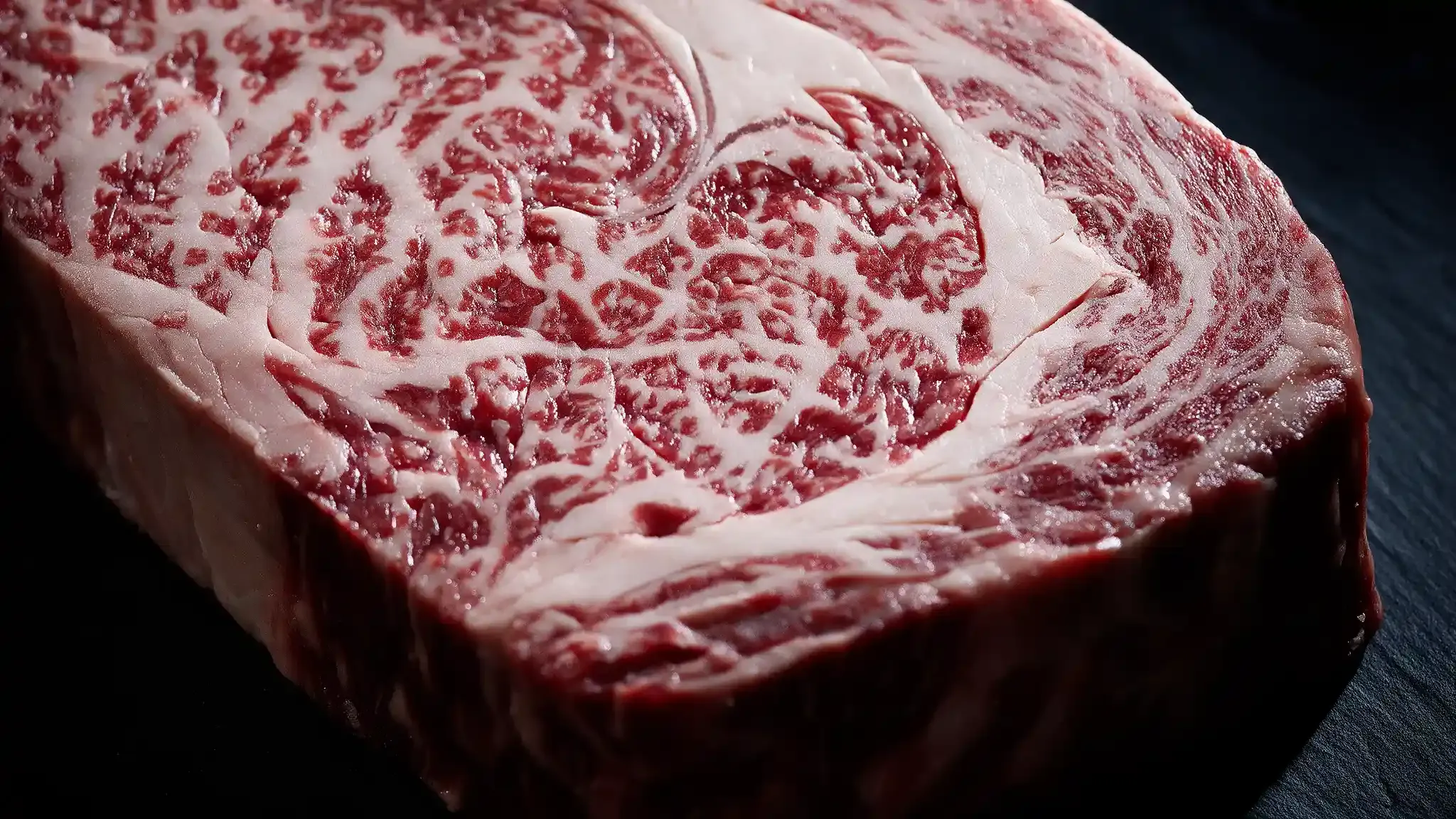
Marbling is fat inside the muscle rather than around it. Those fine white threads running through a steak melt at a lower temperature than the muscle around them, which is why highly marbled beef tastes richer and feels softer.
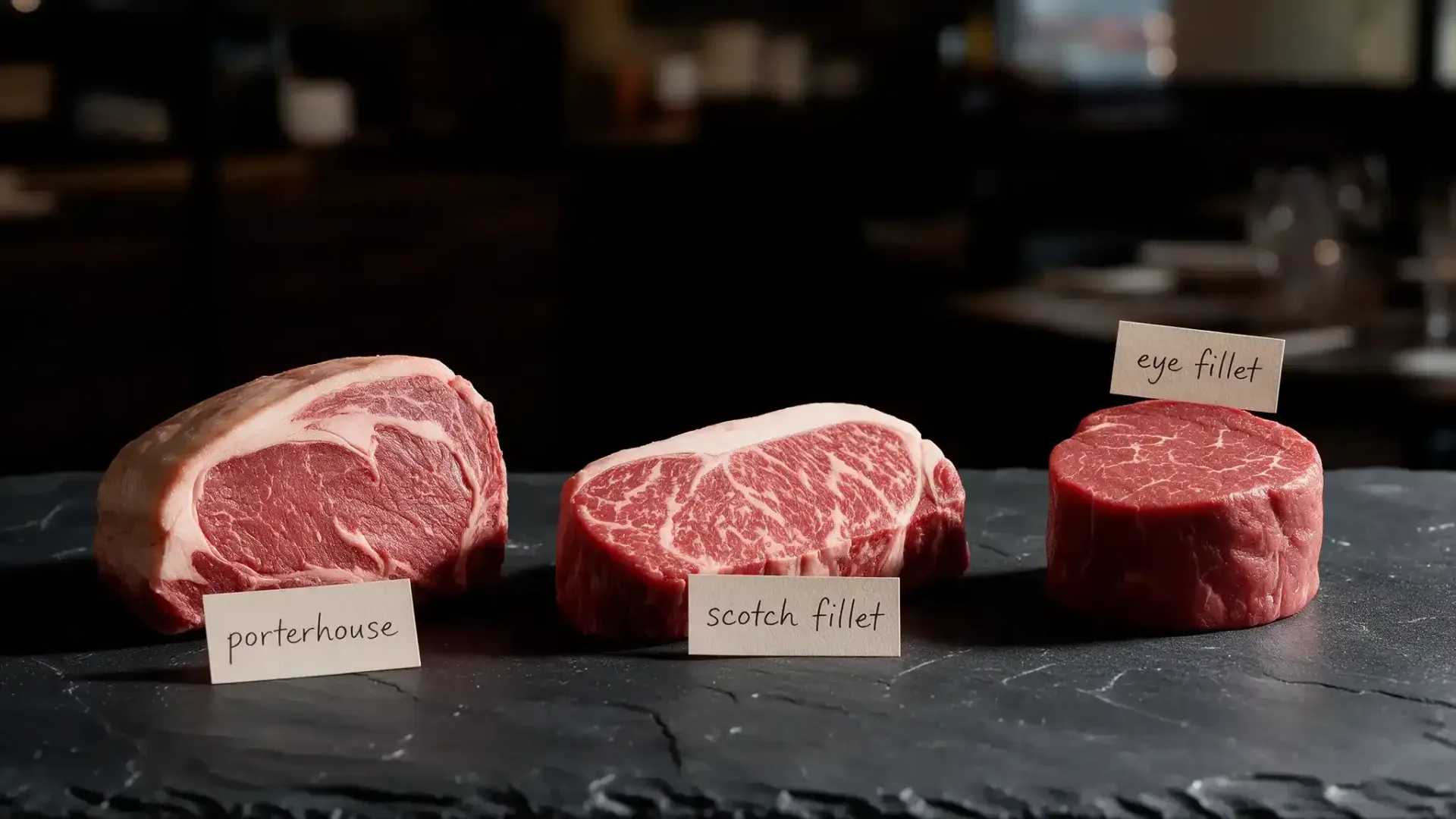
It is not the same as the fat cap on the edge of a porterhouse. That is subcutaneous fat, it renders differently, and it contributes crust rather than internal richness.
The Australian scales, both of them
There are two systems in use here and they confuse almost everybody, including a fair number of people selling beef.
AUS-MEAT
The older and more commonly quoted system. It runs from 0 to 9+ in increments of one, where 0 means essentially no visible marbling and 9+ describes the most heavily marbled Wagyu. When a menu says 'MB7' or 'marble score 7', this is the scale it means.
Meat Standards Australia
Run by Meat & Livestock Australia, MSA takes a broader view. Rather than grading a whole carcass, it grades by individual cut and cooking method, on the basis that a striploin and a chuck roll from the same animal perform very differently on a plate.
MSA's marbling scale runs from 100 to 1190 in increments of ten. It also factors in ossification, which indicates carcass maturity, rib fat depth, pH and temperature at grading. An AUS-MEAT score of 5 typically corresponds to somewhere in the MSA 700 to 800 range.
And the Japanese scale, for comparison
Japan's Beef Marbling Standard runs from 1 to 12. The Australian AUS-MEAT scale broadly aligns with it at comparable numbers, which is useful to know if you are reading an imported label.
Why there are two systems at all
AUS-MEAT came first and does one job: it measures how much marbling is present. MSA was built later to answer a different question — how good will this actually be to eat — which is why it takes in maturity, fat depth and pH as well as marbling.
The practical consequence is that a marketing team can choose whichever number sounds better. A grade 400 sounds more impressive than a grade 5, and is in fact lower. Ask which scale is being quoted.
Who Sher Wagyu are
Nick and Vicki Sher began producing Wagyu in Australia in 1991 through their family company, Beefcorp Australia, based at Ballan in central Victoria with further operations in the Tallangatta Valley.
They imported Wagyu embryos from Japan and calved the first purebred Wagyu embryo calf born in Australia in February 1992. At the time almost nobody in Australia had heard of the meat, and for the early years essentially all of their production was exported to Japan.
Their fullblood herd descends from the three principal Japanese bloodlines — Tajima, Fujiyoshi and Kedaka — and every fullblood animal is DNA registered with pedigrees traceable back to its Japanese ancestors.
Fullblood, crossbred, and what F1 means
Fullblood Wagyu is 100 per cent Wagyu genetics. Crossbred is Wagyu crossed with another breed, and the percentages are given as F1, F2, F3 and purebred.
Sher pioneered Wagyu crossed with Holstein in Australia in 1996 — the traditional Japanese F1 pairing — which produces good beef across a range of marble scores. Higher-percentage crossbreds follow: F2 at around 75 per cent, F3 at around 88 per cent, and purebred at around 94 per cent.
Crossbred Wagyu typically lands somewhere around MB6 to MB8. Fullblood can reach MB9+.
Crossbred is not a lesser product, which is a common misreading. The Holstein cross in particular produces beef across a useful range of marble scores, and for most diners a good F1 at MB6 is a more enjoyable steak than a fullblood at MB9 simply because it is less relentless.
The feeding programme
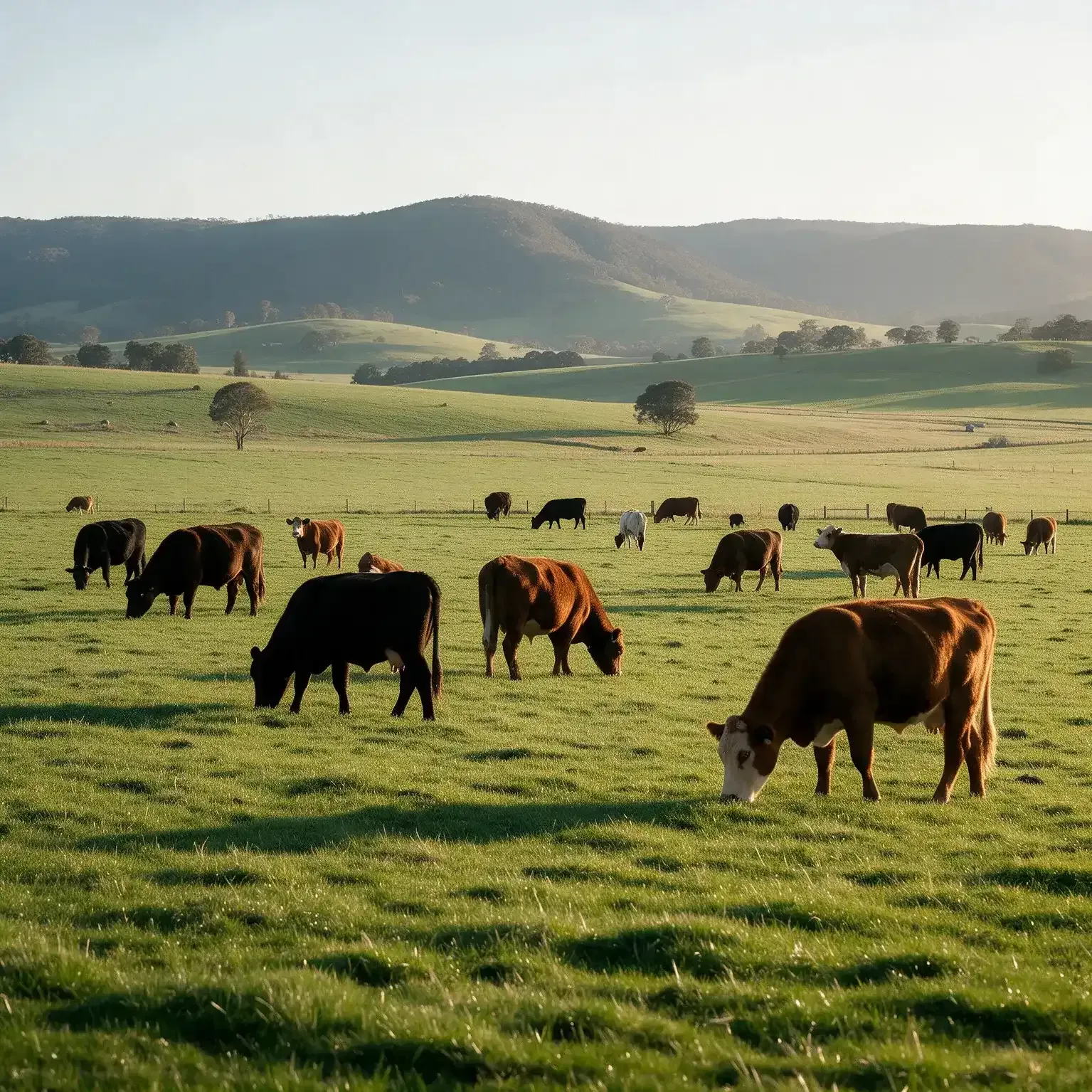
Cattle graze on pasture until roughly 18 to 20 months of age, then move onto a specially formulated Japanese-style barley-based ration for more than 400 days. That extended grain finishing is what puts fat through the muscle.
Sher Wagyu beef is graded for marbling by independent assessors accredited by AUS-MEAT, and is exported to more than fourteen countries. In Japan it is sold as Sher Black, because Japanese regulations restrict the word Wagyu to beef produced there.
What a marble score means at the table
Higher is richer. It is not a quality ranking, and treating it as one leads people to spend more money on a less enjoyable meal.
A marble score of 2 or 3 is a solid everyday steak — leaner, firmer, still juicy, and considerably better value. A score of 4 or 5 sits in the range most people find ideal for a full-sized steak. Above 6, richness becomes the dominant characteristic.
Plenty of experienced eaters prefer the cleaner, more mineral flavour of a grass-fed steak at marble score 3 to something at 8. That is a legitimate preference rather than an uneducated one.
How to order highly marbled beef
Smaller than instinct suggests. This is the single most common mistake and it is expensive. Marbling coats the palate as you eat, so a 150 to 200 gram portion of MB8 delivers as much richness as a considerably larger lean steak.
Order something acidic alongside it — a sharp side, a wine with some acid rather than a heavy oaked red. The point is to reset your palate between bites rather than compound the richness.
And cook it, or have it cooked, less than you would a lean cut. The fat is already doing the work that longer cooking would otherwise be needed to achieve.
Why highly marbled beef is priced the way it is
More than 400 days of grain feeding is expensive. So is a breeding programme that takes generations to establish, and DNA registration on every animal.
The price reflects time and inputs rather than scarcity alone. A fullblood animal has been fed for well over a year longer than a conventional beef animal before it reaches a plate, and someone has carried that cost.
Whether that is worth paying for is a genuine question rather than a rhetorical one. For a special occasion in a small portion, most people would say yes. As a weekly steak, most would not.
Where the number comes from
Marbling is assessed on the cut surface of the carcass at a standard rib site, by graders accredited to do it. Sher Wagyu's beef is assessed by independent AUS-MEAT accredited assessors rather than graded in-house, which matters — a self-declared marble score is not the same thing.
If a menu quotes a marble score without naming a producer or a grading body, it is worth treating the number as indicative rather than certified.
Questions worth asking
Which scale the number refers to. A 'grade 400' sounds higher than a 'grade 5' and is in fact lower, because one is MSA and the other AUS-MEAT.
Fullblood or crossbred, and if crossbred, what percentage. Both are good; they eat differently and are priced differently.
Who the producer is. A named producer with a traceable programme is a meaningfully different proposition from unlabelled beef described only as 'wagyu'.
And how it is being cooked. High marbling and a very hot fast grill are a good combination; high marbling and a long slow cook is usually a waste of both the beef and the money.
None of these questions are unreasonable and none should produce a defensive answer. A restaurant serving good beef is generally pleased to be asked about it.
See Sher Wagyu on our dinner menu, or read more about our wood-fired steakhouse. New to ordering steak generally? A broader guide to ordering steak covers doneness and cuts. Pair your order with what to drink alongside it — or if you are nearby, see where Brighton diners go for steak.
FAQ
What does marble score mean?
It measures intramuscular fat — the fine white threads running through beef. Australia's AUS-MEAT scale runs from 0 to 9+, with higher numbers meaning richer, softer beef.
What is the difference between AUS-MEAT and MSA grading?
AUS-MEAT scores marbling from 0 to 9+. Meat Standards Australia grades by individual cut and cooking method on a scale of 100 to 1190, factoring in maturity, rib fat, pH and temperature.
Is a higher marble score always better?
No. Higher means richer, not better. Many people prefer the cleaner flavour of a grass-fed steak at marble score 3 or 4 to something considerably more marbled.
What is the difference between fullblood and crossbred Wagyu?
Fullblood is 100 per cent Wagyu genetics. Crossbred is Wagyu crossed with another breed, graded F1, F2, F3 and purebred by percentage. Crossbred typically reaches MB6 to MB8; fullblood can reach MB9+.
Where is Sher Wagyu from?
Ballan in central Victoria, with further operations in the Tallangatta Valley. The Sher family have produced Wagyu since 1991 through their company Beefcorp Australia.
How much wagyu should I order?
Less than you think. A 150 to 200 gram portion of highly marbled beef delivers as much richness as a much larger lean steak, because marbling coats the palate as you eat.